
Celebrating 75 Years of Caring and Commitment
Since 1951, the Alabama Nursing Home Association has served as the voice of Alabama’s long term care providers. Explore our history, celebrate our milestones, and discover the people and stories behind 75 years of caring and commitment.
🏛 Governor’s Proclamation | 📰 Press Release | 🎬 Anniversary Video | 📖 Timeline Publication | 📅 Decade Highlights | 💙 75 Stories of Care
75 Years of ANHA
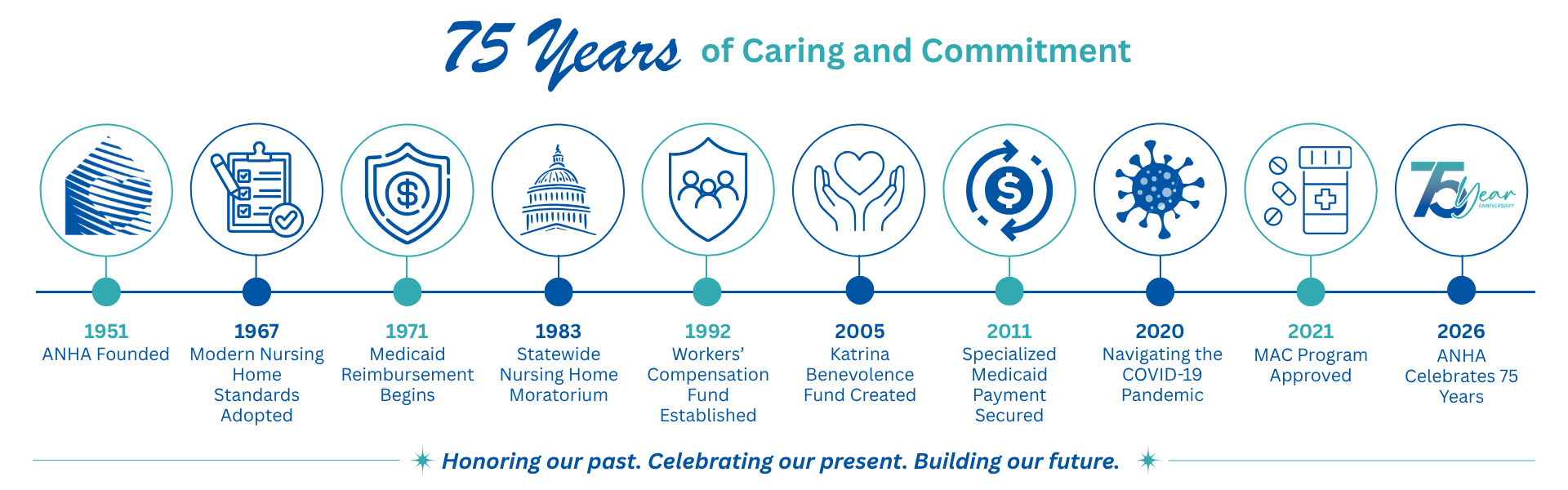
For 75 years, ANHA has worked alongside generations of long term care leaders, caregivers and partners to strengthen care in Alabama. Take a look back at the people, milestones and progress that have shaped our association—and the legacy we continue to build.
75 Years at a Glance
📖 A Legacy of Care
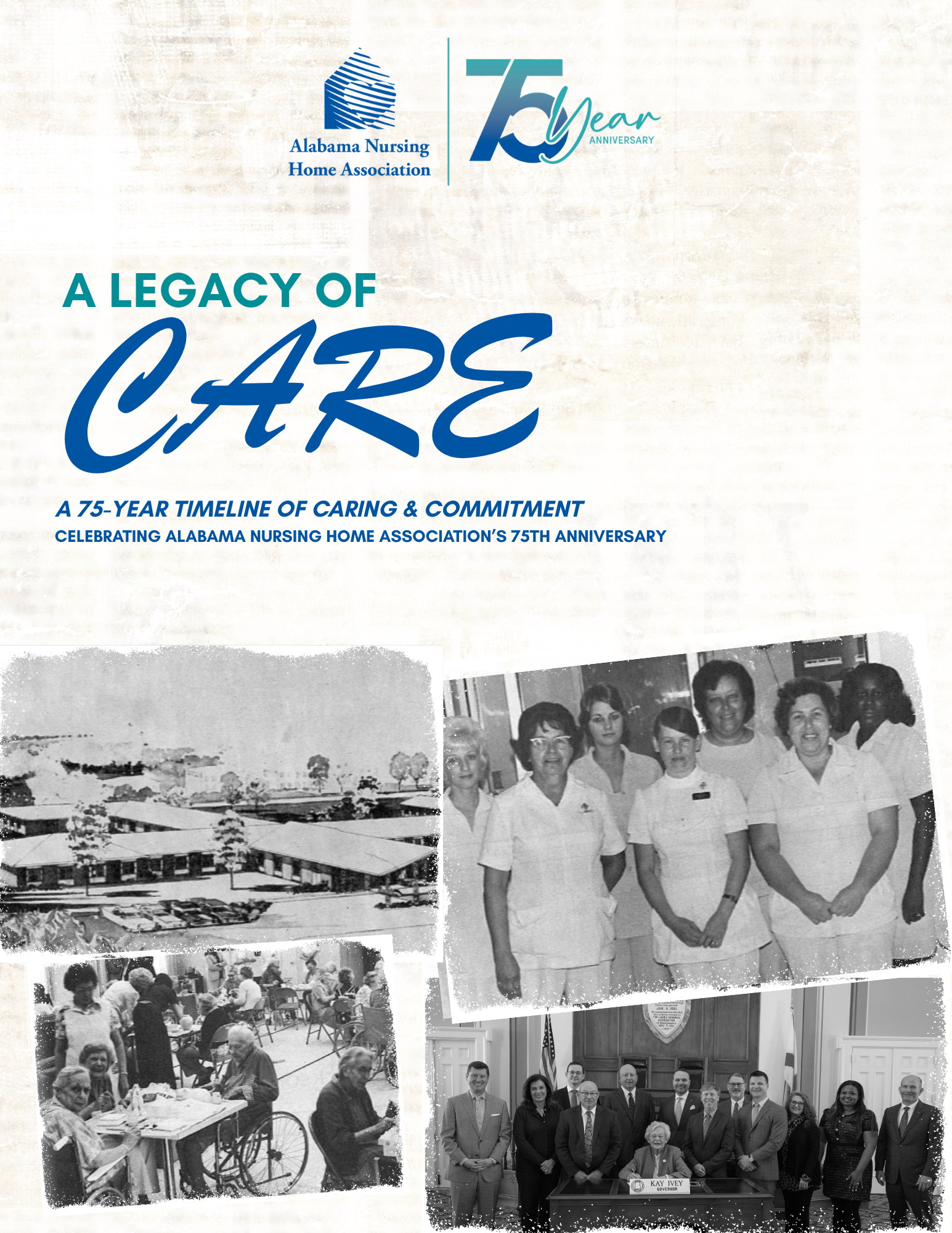
Our commemorative historical timeline chronicles the milestones, achievements and defining moments in the Alabama Nursing Home Association’s history since 1951.
Click the cover below to explore 75 years of ANHA’s history.
📅 Explore Our History by Decade
1950s
- June 7: Alabama Nursing Home Association is born in a courtroom of city hall in Montgomery as the Alabama State Association of Nursing Homes.
- Five individuals are appointed to draft the constitution and bylaws for the Alabama State Association of Nursing Homes.
- July 17: The Alabama State Association of Nursing Homes is officially incorporated, establishing the organization as a formal statewide association.
- Maggie Howell is elected President.
1960s
- 1960: Association membership is 40 homes representing 2,000 beds.
- 1963: The first nursing home since the association’s founding is built in Pleasant Grove, Alabama, costing $80,000 and consisting of 43 beds.
- 1967: Alabama adopts nursing home rules and regulations to align with national standards.
- 1969: The Alabama State Association of Nursing Homes changes its name to become the Alabama Nursing Home Association (ANHA) and completes plans to move offices to Montgomery from Birmingham.
- 1969: Association works with State Board of Health, Alabama Department of Public Health (ADPH) to sponsor and pass legislation to license nursing home administrators. The legislation also creates a nine-member licensure board.
1970s
- 1971: Medicaid reimbursement for nursing homes begins.
- 1973: Public disclosures of statement of deficiencies and plans of correction are implemented.
- 1974: ANHA membership grows to 163 nursing homes.
- 1974: The federally mandated program for health planning is implemented establishing the Region Health Planning Programs (PL 93-641).
- 1976: Medical director requirement for facilities is imposed.
1980s
- 1981: ANHA creates a political action committee known as ANHAPAC.
- 1983: Governor George Wallace issues a moratorium on the construction of new nursing homes and nursing home beds.
- 1984: Association starts the annual Ms. Alabama Nursing Home Pageant. Ms. Myrtle Wise of Oak View Manor in Ozark is chosen as Ms. Alabama Nursing Home.
- 1987: The Omnibus Budget Reconciliation Act of 1987 (OBRA ’87) is enacted, ushering in significant regulatory reforms for nursing homes nationwide.
- 1988: Articles of Incorporation are adopted for the Alabama Nursing Home Association Educational and Research Foundation, Inc.
1990s
- 1991: The Legislature passes a Provider Specific Assessment Program, helping secure funding for nursing home care.
- 1992: Association sets up ANHA Workers’ Compensation Self Insurer’s Fund.
- 1994: Association begins cooperative effort with ADPH and establishes the Alabama Best Practices Program.
- 1997: A new Medicare Prospective Payment Program (PPS) is adopted and the so-called Boren amendment is repealed with the passage of the Balanced Budget Act in Congress.
- 1999: Quality Indicator reports begin to be used by nursing homes and surveyors.
2000s
- 2000: Association begins development of a website.
- 2001: ANHA begins a Customer Satisfaction Program.
- 2005: After Hurricane Katrina, ANHA sets up a Benevolence Fund to assist nursing home personnel who suffer losses due to a natural disaster.
- 2005: ANHA works with Alabama Department of Public Health (ADPH) to develop and implement feeding assistant regulations, effective in May.
- 2007: ADPH announces that all Alabama nursing homes are fully covered by sprinkler and fire suppression systems. Alabama becomes one of the first states in the nation to have every nursing home fully sprinklered.
2010s
- 2011: ADPH launches an online incident reporting system that is encrypted and secure for transmitting personal medical information. This system allows facilities to electronically transmit the initial facility report regarding abuse and neglect allegations, misappropriation of resident property, suspected injuries of unknown origin, and fires.
- 2012: After months of work by ANHA and the Alabama Medicaid Agency, Alabama Medicaid will pay nursing facilities a supplemental fee-for-service payment in addition to the daily nursing facility rate for care provided to ventilator-dependent residents and/or qualified tracheostomy residents who are eligible for Medicaid benefits.
- 2013: ANHA works with the National Center for Disaster Medical Response, University of South Alabama Center for Strategic Health Innovation in the development of a training program specific for nursing homes. In addition, ANHA jointly prepares a Disaster Planning Guidance Manual regarding Sheltering in Place and Evacuations. Seminars across the state occur to roll out the manual.
- 2014: ANHA transitions to a new website and launches an interactive map that allows consumers to easily locate Alabama nursing homes. Users can search by city or zip code to find nursing homes in a specific geographic area. Users can also search by the name of the nursing home.
- 2016: CMS implements a system for facilities to submit staffing and census information. This system, the Payroll-Based Journal (PBJ), allows staffing information to be collected on a regular and more frequent basis and will be auditable to ensure accuracy.
- 2019: ANHA launches the Long Term Care Preparedness Toolkit. The toolkit will assist with emergency preparedness and disaster planning for the specialized health care population served by long term care facilities.
- 2019: ANHA launches Job Board on its website to help member nursing homes recruit new employees.
2020s
- 2020: National and statewide emergencies are declared because of COVID 19. ANHA assists in helping facilities secure PPE and testing kits for COVID 19 and works to ensure facilities have the proper tools for a Respiratory Protection Plan that meets OSHA guidance. ANHA secures a grant through ADPH to obtain fit-test kits for all facilities and provide necessary training throughout the state.
- 2021: After years of hard work, ANHA is successful in working with the ABN to allow Medication Aide Certified (MACs) to assist with medication administration. ABN’s website is updated to feature a page for MACs.
- 2021: The Louis E. Cottrell, Jr. Foundation for Excellence in Long Term Care establishes a process for facilities to access additional funding through ARPA.
- 2023: ANHA offers membership to assisted living facilities (ALFs) who are affiliates of ANHA members. This is available to both ALFs and specialty care assisted living facilities (SCALFs).
- 2026: To commemorate its 75th anniversary, ANHA launches several special initiatives, including the 75 Stories of Care campaign, a commemorative timeline publication, a Governor’s proclamation and other projects celebrating the association’s legacy and the future of long term care.
💙 75 Stories of Care
In celebration of ANHA’s 75th anniversary, we are proud to share 75 Stories of Care—a collection of real stories from our member facilities across Alabama that reflect the heart of long term care. These submissions highlight the compassion, innovation, dedication, and meaningful moments that define our profession. From everyday acts of kindness to extraordinary programs that bring joy and connection, each story represents the impact our members make in the lives of residents and families. As we honor our past and look toward the future, these stories remind us why we exist—and why our work matters. New stories will be added throughout the year as we continue celebrating 75 years of advocacy, leadership, and care.
Explore the 75 Stories of Care Gallery

Honoring our past. Celebrating our present. Building our future.
As ANHA marks 75 years of service, we celebrate the people, progress and purpose that have shaped our history—and look ahead to the future of long term care in Alabama.
