
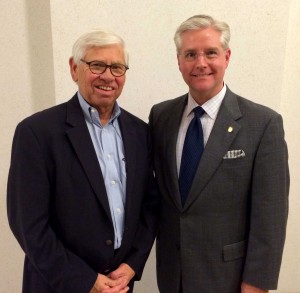
ANHA Legislative Director Jackie Ayers, left, with Sen. Greg Reed (R-Jasper).
The Alabama Nursing Home Association recently sat down with Sen. Greg Reed (R-Jasper) to ask three questions of importance to nursing homes. Sen. Reed is chairman of the Senate Health Committee and represents Senate District Five which includes all or parts of Blount, Jefferson, St. Clair, Tuscaloosa, Walker and Winston counties.
Question one: Work is underway to implement the Medicaid reform measures that were passed in the 2013 Legislative Session. Can you give us an update on where the Medicaid reform process stands?
Sen. Reed: We’ve been working on trying to make sure that everyone was aware of what had transpired in regards to the movement from the fee for service model to the regional care model.
The first order of business was to set the regions. They’ve (Medicaid) moved through to identify the five different regions in the state to where we know who was going to function from different areas and counties in each of the regions. That’s very important for the hospital communities and nursing home communities to be able to know how are we going to be able to collaborate together.
I think one of the biggest questions was can there be more than one RCO in one of the regions. And the answer is yes. The other question is can there be other entities that can be collaborative members of the boards of governors related to the RCOs. And the answer is yes. So you’ve got a lot of those options there.
I think the next thing we’re going to see coming up in 2014 is the coming together of the different entities within a particular region to understand how are we going to organize, who is going to put up the resources and what’s going to be our methodology to move forward as an RCO. And organize ourselves to go to Medicaid and ask for the opportunity to be a preliminary entity to have the option to move forward.
Question two: What role do you see nursing homes and long term care playing the new Medicaid system?
Sen. Reed: I think in some regards its being determined because one of the things that we needed to understand better is what are some of the issues and concerns about nursing homes and long term care moving forward. Where do nursing homes fit within the process? What is their expanded role? Where do other areas of home health and other long term care related topics go together? How is that going to work within the new structure of Medicaid?
There’s a study that has been commissioned. There’s going to be some guidelines in that study to understand here’s how long term care functions today, and with the help of many of the stakeholders in long term care, helping the state of Alabama understand and recognize where do we go from here, what is going to be some of the new options, what are the ways that we do what we do better and we do it more effectively and more efficiently. There’s no doubt that there are going to be more Alabamians getting older, there’s going to be a larger population that are going to need long term care services. So how do we make sure that we make appropriate preparations for the future? I think the study that we’re going to see as a part of the legislation with Senate Bill 340 is going to give us some of that insight in the future.
Question Three: Other than Medicaid funding, what health care topics do you anticipate in the 2014 Legislative Session?
Sen. Reed: One of the issues is going to be what to do with Medicaid pharmacy. That’s been a huge topic. I’m currently serving on the Governor’s commission on Medicaid pharmacy with a number of different members including Frank Brown who represents nursing homes on that particular commission. The big question is how’s the most efficient and effective way to operate Medicaid pharmacy. Obviously, we are looking for a focus on access to care and an issue associated with the idea of local pharmacies and making sure we don’t have a knee jerk reaction to saving money that in the long term costs us economically by rural pharmacies closing because they don’t have enough resources to be able to function. So that is a topic that’s being debated right now. We’re supposed to finalize our work and get some information and results back to the Governor by the time the session starts on January 14.
I think you’re going to continue to see some scope of practice questions with different groups that are looking to increase their scope of practice. We dealt with that with nurse practitioners in the last session, which I think was a very positive thing. There are some other topics that are being discussed in relation to those issues that are of interest to some of the other providers.
I think we’ll also see some issues associated with wellness topics, ways that the state can help promote health care through different programs to get healthy foods in rural areas and to be able to get healthy foods in urban areas.
One other issue that we may see and hear about is the idea of how do we care for children that have significant diseases like diabetes that require injections of insulin. How are we going to deal with that? We don’t have enough school nurses to administer all that. Are there ways that can be done with other school personnel? What are the answers to a lot of those questions? I don’t know at this point, but I see that is a topic that is going to be discussed.
