
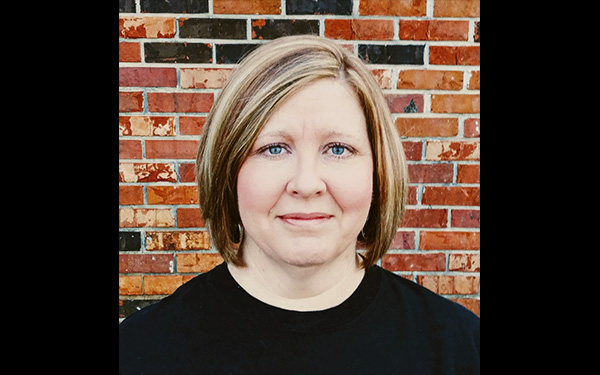
March is National Social Work Month. To highlight the important role of social workers in long-term and post-acute care, ANHA interviewed Lynn Smith, LBSW, Social Services at Talladega Health & Rehab. In our conversation, Smith described different ways a social worker can serve the various types of individuals who live in nursing homes.

Talladega Health and Rehab staff, from the left: Lynn Smith, Activity Coordinator Dorothy Thomas, Social Workers Brittany Denney, Social Worker Shalanda Roberson and Social Worker Vecretta Smith.
ANHA: You work on a staff with three other social workers. Why do you need so many social workers?
Smith: First, it depends on the number of residents. It is also important to keep caseloads manageable, so your staff can properly serve everyone. In Talladega Health and Rehab each social worker covers different units within the nursing home. We have one person that works on the unit with individuals diagnosed with Alzheimer’s and dementia. Another person works on a long-term care unit with residents who are more independent. A third person works with people who are somewhat independent and require more moderate care. I work on a unit with individuals who require acute care both medically and with activities of daily living.
ANHA: How do social workers best serve such a diverse group of individuals?
Smith: We use a different approach based on the individual’s needs. For someone who is alert and oriented and able to do things for themselves, the best way you can serve them is to encourage them to continue to maintain the abilities they have. It is important to encourage them to socialize with others and assist them in adjusting to living in a nursing facility. Many times, that is what they struggle with the most. They didn’t expect to need nursing home care so soon, and they need help with the adjustment. It takes a lot of conversation with that person and relationship building.
ANHA: What if someone has strong cognitive abilities, but requires a lot of assistance with activities of daily living?
Smith: We have activity professionals who conduct one-on-one activities in the rooms of residents who cannot participate in regular activities. The resident also interacts with their nurses, nursing assistants and other staff. Hopefully, they can socialize with their roommate too. The social worker, closely monitors these individuals to make sure their social and other needs are met and they’re receiving services best suited to their needs.
ANHA: How do you develop a relationship with a person diagnosed with Alzheimer’s or dementia?
Smith: It’s a matter of seeing them every day and having a conversation with them every day. Even if they don’t know who you are and don’t remember you from day to day, if you have that warmth every time you have a conversation with them, they start to remember the feeling they have when you come around. Building that rapport helps when you come upon a time they are struggling or not wanting to do something such as take a shower. You’ve built a relationship with them through daily contact and it is easier to reason with them and convince them to cooperate.
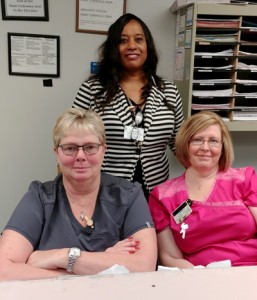
Seated from the left: Nurse Manager Lisa Wesley and Social Worker Lynn Smith. Standing: Floor Administrator Lynn Hann.
ANHA: Many of our readers may not know that nursing homes care of younger individuals. How do you serve them?
Smith: You must approach them in a way that communicates that you understand they’re not where they intended to be. They are much younger than a “typical” nursing home resident. They had their whole life in front of them and something happened that changed their whole plan. This is off-timing the developmental stages of their life. The reality is they’re going to be more demanding than an older individual. As a social worker, a lot of what I do is advocate for more age appropriate opportunities for them. Nursing facilities must evolve and perhaps have an area in the facility that is just for younger people. Activity programs must be geared toward their age level.
ANHA: Is it more difficult to build relationships with younger people or older people?
Smith: It’s more difficult to build relationships with younger residents. It relates to them not wanting to be there because something caused them to need the high level of nursing home care. They’re dealing with a loss of their original plan for their life. That makes them not as trusting and it’s harder to build trust. I’m not very good at “tough love” and sometimes that’s what it takes. They have to accept their reality, and you let them know you’re going to work hard to do anything you can to give them the quality of life they deserve, but they’ve got to work with you. Sometimes, that’s hard for me to say and hard for them to hear. Remember, you have to maintain your professionalism and be respectful when you have those hard conversations. It’s a difficult balance, but you must do it in order to best serve the resident.
About Lynn Smith
Lynn Smith, LBSW, works in Social Service at Talladega Health & Rehab. She earned a Bachelor of Science in Social Work from Jacksonville State University. She is currently enrolled in the Master of Social Work program at the University of Alabama. She represents Region 4 on the ANHA Activity & Social Service Auxiliary Board.
