
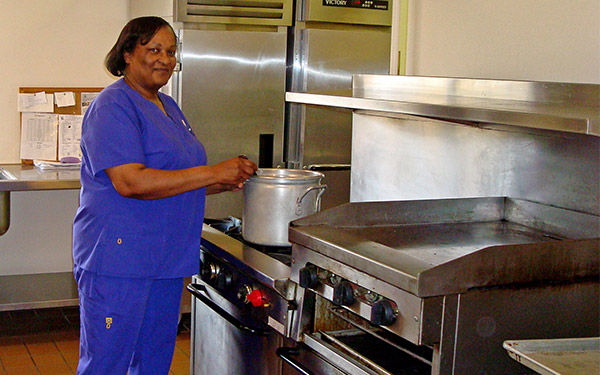
Good food goes a long way towards good health. That’s especially true in nursing homes were residents live long-term in their home away from home. Good food leads to a higher quality of life, and better health outcomes because the patient receives proper nutrition.
Because February 1-5 is Pride in Foodservice Week, ANHA spoke with Alice Smart, Dietary Manager at Orchard Rehab & HealthCare Center in Hayneville, to learn more about nursing home foodservice. Smart began her long-term care career in 1994 as a Certified Nursing Assistant. She became a dietary manger in 2002 and earned her certification in 2008. She has served as Orchard’s Dietary Manager since 2010. Smart is a member of the Association of Nutrition and Foodservice Professionals.
ANHA: Describe the duties and responsibilities of a dietary manager?
Alice Smart: A dietary manager in a nursing home has an umbrella responsibility. I do scheduling for the staff, order the groceries and supplies, handle the time sheets for payroll and assess the needs of new and returning residents. I assess the residents to find out what their needs are and their food preferences. I get all of the information ready for the registered dietician to review. I communicate with the staff to assess how the residents are eating. Along with all other department heads, I attend care plan meetings to see if a resident has any concerns regarding their diet.

Orchard Rehab & HealthCare Center’s dietary staff, from left to right, Henrietta Hills, Shirley Walker, Darneal Cain, Bertha Hrobowski, Alice Smart and Eddie Moore. Not pictured are Jermael Crenshaw and Linda Reed.
ANHA: Tell us about Orchard’s dietary staff.
Smart: We have dietary aides and cooks, seven employees. The dietary aides are responsible for the beverages. They make the coffee, tea, lemonade, whatever beverages are served that day. All of our desserts are made from scratch and the aides make those daily. They setup trays and make sure the resident has the condiments needed and then serve the food to the residents at meal time. They also wash the dishes and handle other tasks each day. The cooks cook all of the meals: breakfast, lunch and dinner every day. When we receive new recipes, they follow the instructions and test the food. The cooks also prepare the food for any special events we host like parties, meetings or banquets.
ANHA: How does dietary management relate to a resident’s care plan?
Smart: We have committee meetings to discuss weight loss and other parts of a resident’s health as it relates to food. My role is to work with the restorative nurse who monitors the body weight of all of our residents. If someone is experiencing weight loss, we might give them a nutritional supplement if their appetite is not strong. If their appetite is strong, we can increase their meals to a larger portion or offer specially planned snacks between meals. We already have snacks three times a day for all of our residents. If we put them on planned snacks, it might be high calorie food such as a sandwich with juice to give them the calories they need to increase their weight.
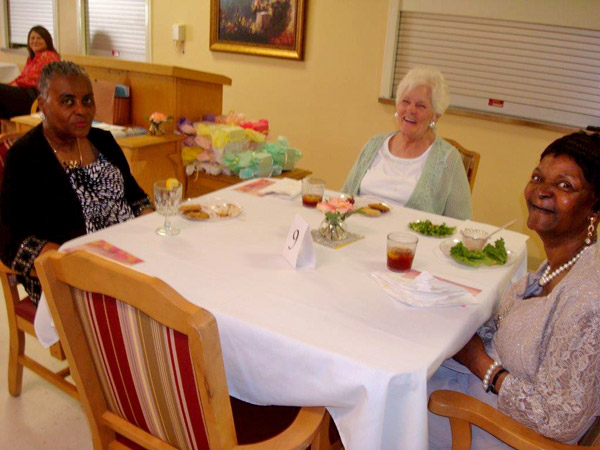
From left to right: Orchard Rehab & HealthCare residents Frances Spruill, Ruth Hicks and Doris Miles enjoy the Mother’s Day Tea.
ANHA: This may be an obvious question, but why is it important for food to taste good?
Smart: The food must taste good. If it doesn’t taste good, then the residents will not eat it. It has to be attractive to the eye on the plate because if it doesn’t look attractive, they’re not going to want to taste it. So we have to make it attractive and then we have to make sure that the food is seasoned good. Every day, before anything goes out of the kitchen, I sample all of it. I try to make sure everything tastes good and when I’m out of the building, the administrator does it for me. We always try to serve good food and to serve good quality food because this is our marketing tool. People will leave our nursing home and tell people in the surrounding community that either the food was good or it wasn’t. We always want to have a good response. Also, we’re located in a rural area and we’re used to eating country food or home cooking. So we want to give our residents what they’re used to eating so they will enjoy eating and maintain better health.

Homemade desserts made by the dietary staff of Orchard Rehab & HealthCare Center.
ANHA: What changes have you seen during your long-term care career?
Smart: The changes in foodservice is that we now try to make it more “home-like” for the residents. We have fine dining in our dining room with linen table cloths and napkins and long stemmed glasses. This makes the residents want to get dressed up for lunch and dinner. It gives them something to look forward to. We play easy listening music and our staff serves them restaurant style. Years ago, we had diets that focused directly on your medical diagnosis. For example, it you were diabetic, you were on a 1500-1800 calorie diet. People with high blood pressure would be placed on a two grams of sodium diet. Today, the diets are more liberal and don’t have as many limitations. Now, people with high blood pressure have no added salt so it’s important that we season the food correctly because they can’t add salt once they receive the meal. People with diabetes just can’t have concentrated sweets or sweet sugar desserts. We have recipes where we can make desserts for the diabetics as well. These changes make the residents more satisfied and they enjoy their food better.
ANHA: What do you enjoy most about your job?
Smart: I enjoy seeing a smile on a resident’s face. I enjoy sitting and talking to a resident and being able to satisfy them. My goal is to satisfy them and to see them happy. When I walk down the hall, there are several residents who let me know how the meal was. They’ll stop me and let me know if something was wrong. If it’s good, they stop me, say they enjoyed everything and ask if I have any extra to save for their dinner. That makes my day!
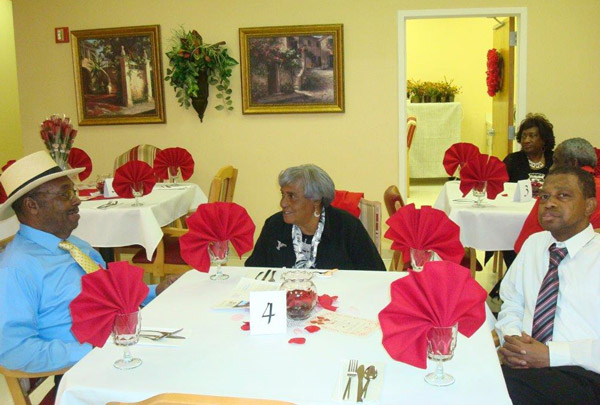
From left to right: Orchard Rehab & HealthCare Center resident Joe Holcombe and his Bertha Holcombe, and residentHayward Lasiter. This photo was taken at Orchard’s 2015 Valentine’s Banquet.
ANHA: Why should someone consider dietary management as a career?
Smart: This has to be something you have a passion for. Everyone can’t be a dietary manager. Some jobs you can do just for the money, but dietary management is a passion because it is never ending. It’s not a job where you can come in and work four or five hours. The dietary manager is called on even when he or she is off work. You’ve got to be willing to take those calls and not let it stress you. You’ve got to be able to do what you ask others to do. You have to have love in your heart to work in this setting. Anybody can be trained to cook, but you can’t teach a person how to love.
ANHA: Why do you work in a nursing home instead of another setting?
Smart: I’m passionate about working with the elderly. I’ve worked in a hospital in a dietary setting, but it wasn’t the same because I didn’t have the one-on-one time with the patients. Within the nursing home, I have one-on-one time with the residents every day. It’s like leaving one family and going to another one. I don’t think I would want to work anywhere, but in a nursing home.
Click here for more information about Pride in Nutrition and Foodservice Week.
