
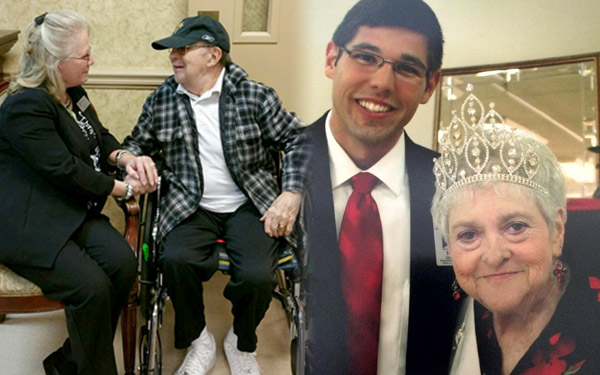
A nursing home administrator is similar to the captain of large ship. He or she is ultimately responsible for everything that happens at the skilled nursing care center.
Administrators chart the course and steer employees in a direction that will lead to a successful health care voyage for the nursing home’s residents.
To celebrate National Long-Term Care Administrator’s Week, March 8-14, we asked two nursing home administrators about their career choice and what advice they would give someone considering a career in long-term care administration.
Administrators:
Laura Saxon began her career as a bookkeeper at Lynwood Healthcare & Rehab Center in Mobile in 1979. She has been a licensed nursing home administrator for 26 years. Laura served as administrator for several nursing homes and came back to Lynwood in 2008.
Trent Jackson began his long-term care career as a teenager and has progressed through jobs of increasing responsibility. Currently, he serves as executive director of the Village a Cook Springs. Trent earned his nursing home and assisted living administrator licenses in 2007.
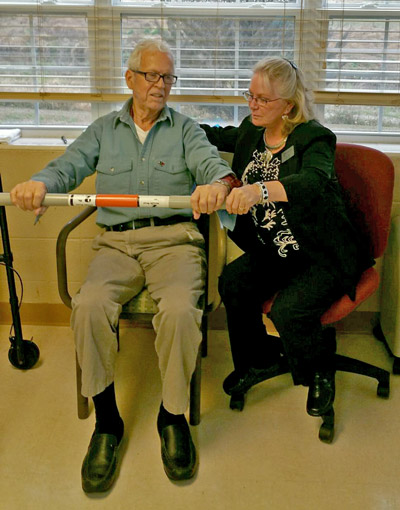
Lynwood Healthcare & Rehab Center Administrator Laura Saxon assists resident Thomas Bosarge with therapy.
Why did you choose LTC administration?
Laura Saxon: I started at Lynwood in 1979 as the bookkeeper and that really launched it. After working in a nursing home, I couldn’t find myself doing anything else. I enjoyed being out on the hall with the staff and the residents. I have great customer service so it was a natural move into administration. Never in my wildest dreams, when I was younger, did I think I would be a nursing home administrator.
Trent Jackson: I walked into a nursing home in May of 1998 as a high school student and simply feel in love. From the minute I walked in that door, I knew that’s where I wanted to be. It became a calling. I’m not sure if I chose long-term care or if it chose me. I knew as a teenager that this was a profession that I wanted to be a part of. I’ve worked as a care assistant, unit clerk, as a cook and just always found my love to be serving seniors in the nursing home setting.
What is the biggest change or changes you’ve noticed in your career?
Laura: With the onset of OBRA* we could no longer physically restrain our residents and really looked closer at their medications to make sure we weren’t chemically restraining as well. Our facilities became more patient centered and our focus changed. We had to adapt to the changes in OBRA and how we treated our residents because we weren’t just getting geriatric patients. Their acuity levels have changed. We’re getting younger people and we individualize our care to meet the patient’s needs. It has made all of us, as administrators, focus on what’s really important which is the resident.
*Editor’s Note: OBRA refers to the Omnibus Budget Reconciliation Act of 1987. OBRA is also known as the Nursing Home Reform Act. It made major changes to the operation of nursing centers.
As a young administrator, how do you motivate employees who are older than you?

Village at Cook Springs Administrator Trent Jackson with resident Doris Chappell.
Trent: Working in long-term care is hard work, but it is also “heart work.” I’ve been a nursing assistant, cook, admissions coordinator. When you’ve walked in those roles you know how difficult they are. It’s important to put yourself in the place of the employee. If you show respect, most times respect will be shown in return to you. If you speak kind words, you receive kind words often times. People like to be acknowledged so walk through the building and call them by their first name and tell them you appreciate what they do. People will respond to the positive feedback.
What advice would you give to new LTC administrators or someone considering it as a career?
Laura: What we do day in and day out is a ministry. So as caregivers, that’s how we have to look at it. I tell all of the employees that compassion is free. It doesn’t cost a thing, but you can’t buy pills that will make your heart feel better than what we do. Remember, customer service can make the difference between maybe a bad outcome or a great outcome. You have to be out there visible to your staff, residents and families everyday…showing great customer service and caring about the residents. Also, if you don’t have compassion, you’ll never make a good administrator.
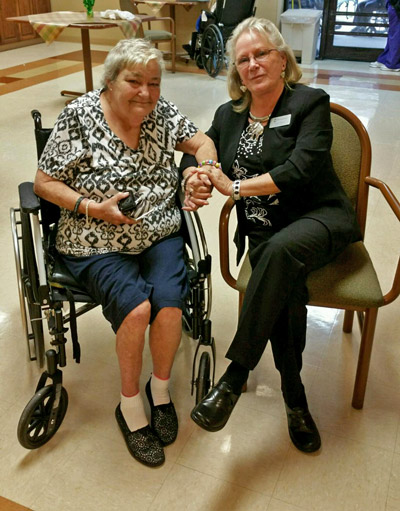
Lynwood Healthcare & Rehab Center Administrator Laura Saxon with resident Patsy Blackmon.
Trent: Long-term care is extremely challenging, but it is also extremely rewarding. When you look at the short number of years we have on this earth to work, I choose this work because it matters. Long-term care is really a lifestyle choice, its 24 hours a day, 7 days a week and the weight of the building rests on your shoulders. It’s a grand responsibility, but there’s also a grand reward that comes with that. You could call it a labor of love. When I was in school, I thought my job would be to love and care for senior adults. However, I’ve come to realize that my job as an administrator is to love and care for the employees so they in return can love and care for the residents.
The Alabama Nursing Home Association thanks nursing home administrators for their hard work and dedication during this week of recognition.
About Long-Term Care Administrator’s Week:
The American College of Health Care Administrators (ACHCA) is the sponsor of Long-Term Care Administrator’s Week. For suggestions on honoring and recognizing an Administrator, please visit www.achca.org. Founded in 1962, ACHCA is the only professional association devoted solely to meeting the professional needs of today’s post-acute and ageing services administrators and executives. Focused on advancing leadership excellence, ACHCA provides professional education and certification to administrators from across the spectrum of long-term care.
-

- Lynwood Healthcare & Rehab Center employees from left to right: Tina Winchester, Latanza Dawkins, Laura Saxon, Irish Quiatson, Jacoby Frazier and Tracey German.
-
- Lynwood Healthcare & Rehab Center Administrator Laura Saxon with resident Ray Rogers.
-
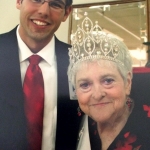
- Village at Cook Springs Administrator Trent Jackson with 2014 Ms. Village at Cook Springs Sharon Enyart.
-
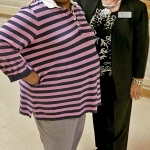
- Lynwood Healthcare & Rehab Center Administrator Laura Saxon with Geneva Rankin.
